Edward reigned from 1307 to 1327 - when he was deposed by his wife, Isabella, and her lover Roger Mortimer. His reign was a particularly messy due to a number of reasons: his choice of favourites which resulted in conflict between Edward and his barons, and importantly his loss of the Scottish lands in the battle of Bannockburn. He is often styled a poor king and a failure because he failed to keep the nobility together - eventually resulting in a civil war. Essentially he was a tyrant. He was one of the first king's to hang a member of the royal family for revolting against him (poor Thomas of Lancaster) and he was also particularly brutal to the nobles who rebelled against him.
Edward was eventually deposed by his own men, but refused to step down or come to parliament to discuss his abdication. There is great controversy surrounding the deposition of Edward and whether or not it was done legally. This is due to the fact parliament was held without the king present to discuss the terms of his 'abdication'.
The first place we visited was Tewksbury Abbey. The Abbey itself is an important structure in the fourteenth century. Originally built in the early twelfth century by Robert FitzHamon, it was a Benedict house and contains many Norman features. It was later added to in the fourteenth century and updated to include the Decorated style that was in fashion in the period. During the reign of Edward II, it was under the patronage of the Clare’s – a prestigious family who held the Earldom of Gloucester. Within the Abbey itself there are many memorials to the Clare’s in the stained glass windows. It also houses the tomb of Hugh Despenser, who married Elizabeth de Clare after her brother, Earl Gilbert, died in Bannockburn.
 This is east end of the Abbey. The curving mark on the floor is where the Lady Chapel should have stood but it was destroyed in the reformation in the sixteenth century and the stone was used elsewhere.
Architecturally it is plain to see this is a medieval church. The windows themselves are the biggest clue. The four leaf clover design, called quatrefoils. They are prominent in many medieval buildings.
 Above is the view of the windows at the East end of the Abbey close up. From this angle you can clearly see the quatrefoils in the top of the window and also on the lower part from the vertical spikes (called steeply pointed gables) you can just make out the black inner scrolling. These are ogge’s due to the fact they make an O and G shape. The windows again are depicted below.
 Below is the south end of the Abbey. Again there you can see the steeply pointed gables.
 This is the northern face of the abbey. On the right hand side is a buttress which supports the structure and basically stops it falling down!!
Within the Abbey is the tombs of various de Clare’s, but this tomb belongs to Hugh Despenser himself. One of the King’s favourites, Hugh Despenser was hated by the other magnates of the realm because he had the king’s ear. He was a bit of a bugger and stole a lot of lands from many of the Marcher Lords, which, as you can imagine, didn’t go down to well. When Edward was deposed Hugh the Younger fell with him. He was captured at Caerphilly Castle in south Wales, hung until nearly dead, cut down and castrated and then quartered before having his head chopped off. Not a nice way to go, but I guess it teaches you not to piss the powers of the realm off! There is no way of really knowing if the bones in the tomb are Hugh’s because tombs were often moved around during the middle ages. Even the top part of the tomb itself is not original. Notable facts about this grave site include the lack of heraldry on the sides, the removal of the twelve disciples and Christ from the decoration above the semi-circle decoration and the lack of an effigy on the marble slab. There could be a number of reasons for this. The lack of heraldry could be because when Hugh was hanged, he was striped of his coat of arms for being a traitor against the state.

This is the tomb next to Hugh Despenser the Younger. If you look carefully you can see the shields on the side of the stonework. This is probably what should have been on the side of Hugh’s tomb. The paint work has since been rubbed off over the ages.

This is the tomb of Edward Despenser. Unlike Hugh’s there is a lot of fine detail on the structure and even a casted effigy of the man on top of the coffin itself.


 Below is the southern transept of the cathedral, leading down to the central part of the nave and the east end – eventually, to the lady chapel. Again note the quatrefoils on the windows and the crenelations along the top. Crenelations are generally associated with castles but they are also prominent in church buildings also. The tower itself is held up by a series of buttresses that were applied in the middle ages when the south transept began to subside and fall. One of the kings own stone masons, a man called Thomas of Canterbury, was called in to solve the problem and came up with an ingenious design to hold the structure up.
 The picture above shows one of the buttresses running through the inside of the south transept to hold the cathedral up after its near collapse in the 1300s.
The picture above is the Lady Chapel at Gloucester. It is one of the few to survive the reformation. It is grander than the Lady Chapel at Lichfield Cathedral which was build by Walter Langton.

This is what is called a Mason’s block. By standing underneath it the mason can gauge if the tower is being competed straight or not. The depiction on it is a memorial to a boy who fell from the roof whilst working on the tower and died. Remember its 225ft high… ouch.

This is the stained glass window that sits almost opposite Edward’s tomb. It is not fourteenth century but rather nineteenth and is dedicated to a man called Edward Douglas – which you can just make out the Latin on the third pane at the bottom for.

This is on the north side of the cathedral and is the cloister – where the monks would have resided. Its unique in the fact that it survived the reformation largely in tact. These are the corridors they would have used to move between the nave and the dormitories (housed on the first floor) the Refectory and the lavatorium (were the monks washed their hands before dinner). Incidentally it was also used in the filming of Harry Potter!! Exciting stuff!
 This picture above actually has nothing to do with Edward’s reign and in fact sits outside the Gloucester monastic borough. It is in fact the ruins of an Anglo-Saxon church from the tenth century and at one time housed the bones of both a king and a saint! (he was eventually moved to Chester).
Caerphilly Castle
The next stop was the famous Caerphilly Castle, located in the Welsh Marches. Said to be one of the greatest medieval stronghold's in Europe, it is one of the most astounding pieces of architecture ever raised in the period. Unlike most castles, Caerphilly was not raised for the King but for a powerful magnate.

A truly foreboding structure, built by Gilbert ‘Red’ de Clare, Earl of Gloucester and Hertford and Marcher Lord of Glamorgan between 1268 to 1271, it eventually passed into Hugh Despenser’s hands following his marriage to Elizabeth de Clare. This is the view from the south side. Despite being mostly ruinous, it still had an eerie as hell vibe to it.
The grass would have been filled with water during a siege, and this water flow was control by a series of dams. This is the outer curtain wall, complete with a round tower. The picture below is also a part of the outer walls and has large square buttresses.

This is the outer main gatehouse and one of the entrances into the castle. Having made it to this point, an attacking army would have had to get across a drawbridge, break through the portcullis (see below picture), and cross another drawbridge to gain access to the middle ward! All the while soldiers would have been firing arrows, rocks, throwing tar and pitch at the attacking force! The castle has only been besieged on two occasions but neither were successful attempts. I think possibly the vastness of the moat plus all those other obstacles were enough to put any invading force off! Oh and the middle ward isn’t even the end of the line. They still had to breach the inner gate house to get into the inner ward were the Lord resided! They also have really lovely things called 'murder holes' which are holes in the floor on the upper levels were they would pour rocks and hot pitch on people running through the portcullis's. Eek!

The portcullis on the outer main gatehouse. In the background you can just make out the Outer East gatehouse.
Stood in the inner moat. View of the Outer East Gatehouse – and most importantly the gift shop!!
The inner ward. Showing the inner side of the inner east gatehouse.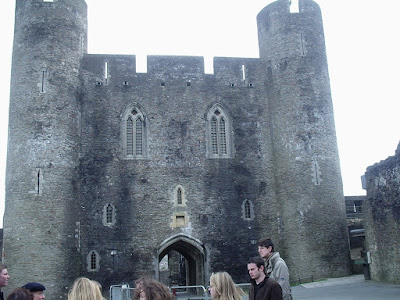
The great hall. Hugh Despenser’s heraldry is on the wall, third one in with the black diagonal stripe across it. The picture below is the outside of the great hall with the private apartments attached. These are both part of a renovation programme.


This is my entire history group in the Great Hall. Tim in the lord's chair because he would have been an incompetent King... much like Edward himself was!


 Well what prompted this was a link I was sent about a TV quiz show in America, staring Kelly


